Axon()
Managed inference, billed to your Axon balance. The default, and the only provider that needs no setup beyond being signed in.
export default defineProfile({
    providers: [Axon()],
})
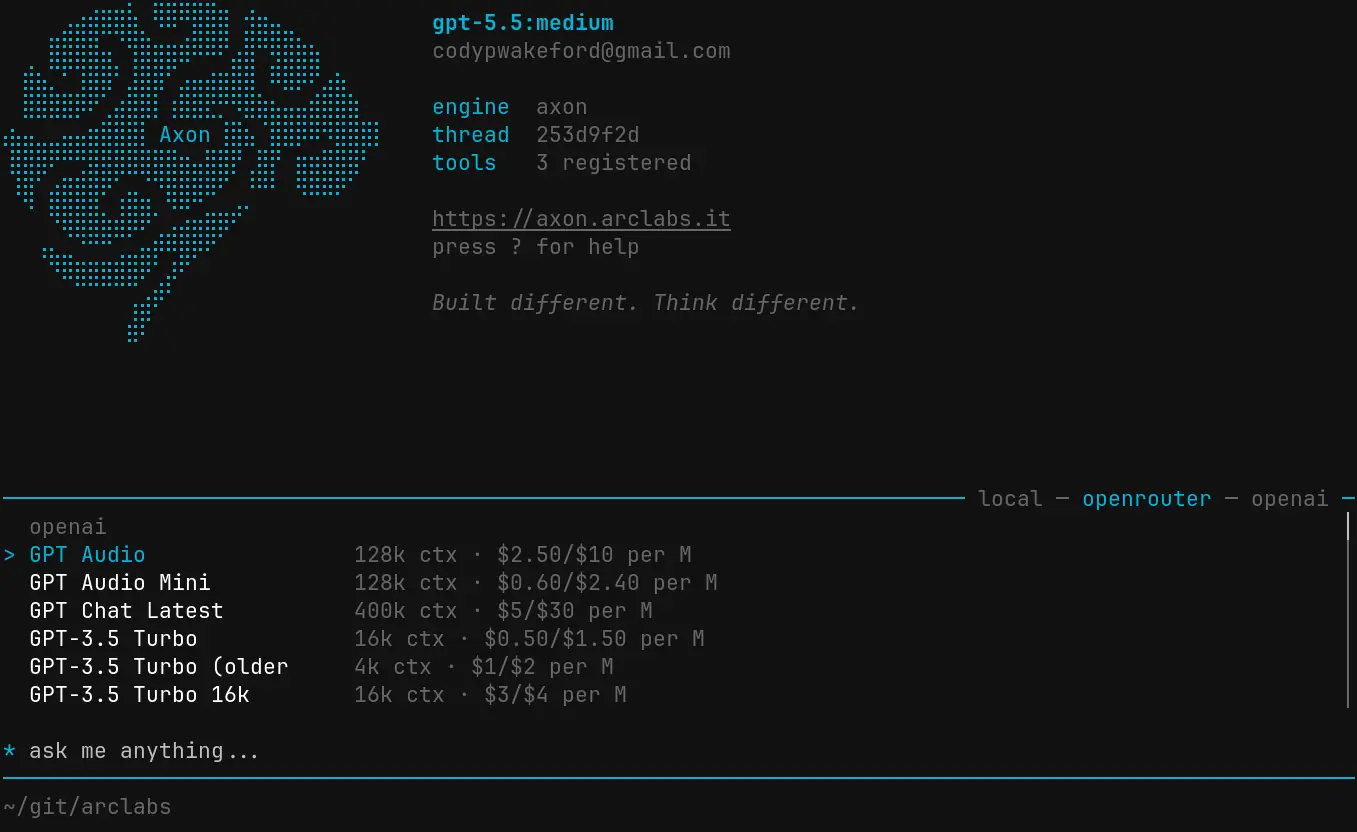
Its catalogue is the full curated list — everything reachable through OpenRouter — so on this provider alone every generate role a cognet can declare resolves. That is why an ordinary user never meets any of the rest of this tab.
Credentials
None. Authentication derives from your signed-in session, so a deployed agent uses the same account the terminal does and a rotated token needs nothing re-entered.
axon login
Options
Axon(options?: ProviderOptions)
| Option | Default | Description |
|---|---|---|
slots | unbounded | Ceiling on concurrent calls a fanned-out role may spend here |
key | — | Not used. Managed inference authenticates from your session |
url | — | Not used |
Free credits, and topping up
Every new account starts with free credits — enough to boot an agent, watch it call a tool, reason over the result, and answer, before you spend anything. No card required.
When they run low, add more from billing. Credits power managed inference plus Axon's own services: deployments, voice, and speech-to-text. Nothing else draws on your balance.
Billing
Usage is metered from the provider's own accounting server-side, and the terminal event carries the authoritative token counts and cost for each call. Every other provider on this tab bills through your own account instead and leaves your Axon balance untouched.
Automatic model selection
model: "auto" lets the server pick, weighted by what you care about:
export default defineAgent({
    model: "auto",
    optimize: { cost: 2, intelligence: 1 },
    limit: { cost: 5 },
})
Weights are normalized, so { cost: 2, intelligence: 1 } and { cost: 0.5, intelligence: 0.25 }
are the same request. limit is a hard ceiling applied before scoring — a candidate that
fails it is never a possible pick, at any weight.
Resolution happens server-side against a curated table, so a curation update — a new
frontier model, a price change, a model getting pulled — reaches every agent using auto
with no client update. auto is the one model: value that is not a real model id; a
client showing it should say so.
Only meaningful on this provider.